


Not every issue belongs in the boardroom. But those that threaten long-term value do – issues that, if poorly managed, can expose a company to significant operational risk. Here’s why nature should be on your board’s agenda, writes Lisa Kusters.
Nature underpins the food we eat, the energy we use, the water we depend on, and the raw materials businesses rely on to operate. Strip it away and operations stall, supply chains fail, costs rise, risks multiply, ultimately shaping financial outcomes.
These are not distant concerns: the World Economic Forum’s Global Risks Report (Figure 1) ranks extreme weather, biodiversity loss, ecosystem collapse and natural resource shortages among the most severe global threats facing the world over the next decade.
Figure 1: Global Risks by Severity

Directors’ duties require them to act in the best interests of a company and to exercise prudence in managing risks. Where nature-related risks are material and increasingly foreseeable, failing to consider them raises questions of governance and accountability.
The Scale of Business Dependence on Nature
A significant share of the global economy depends on the natural environment. Much of this risk is hidden in supply chains, making it harder to detect.
A food retailer, for example, may appear to have limited financial risk – its direct operations being primarily stores, warehouses and distribution networks. A significant portion of its supply chain, however, depends on farmers, who rely on healthy soils and reliable rainfall to produce the goods that ultimately reach the retailer’s shelves.
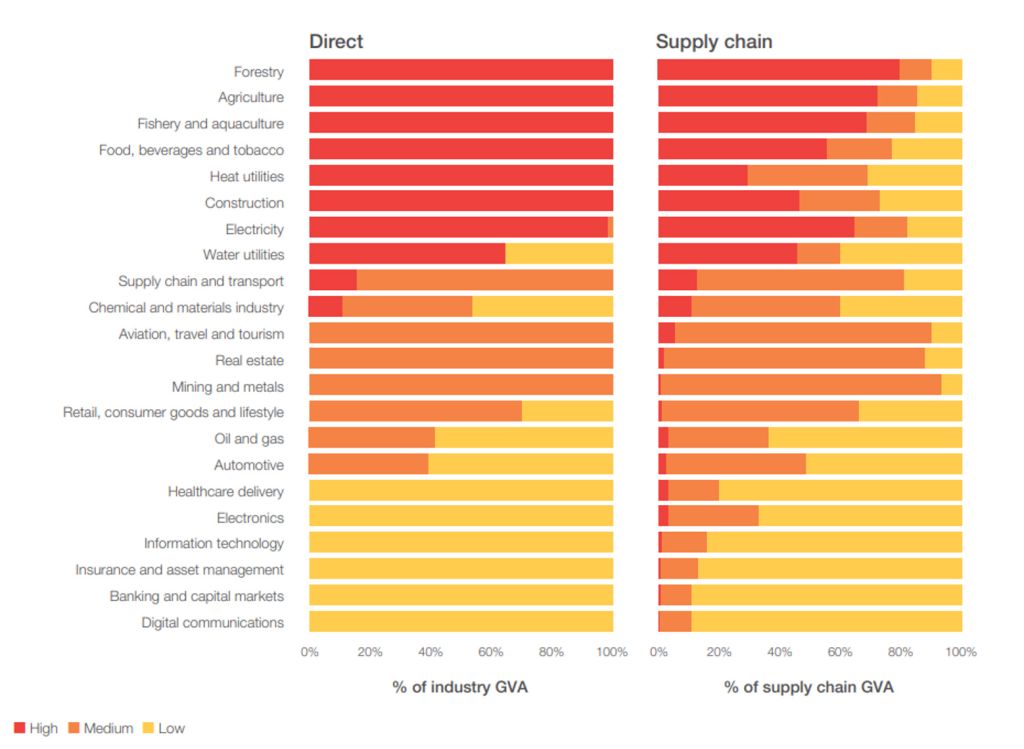
In fact, agriculture and sectors like forestry, construction, and utilities are among the most dependent on ecosystem services, measured as a share of gross value added (GVA), according to a PwC analysis in the Nature Risk Rising report. (Figure 2).
Figure 2: Percentage of direct and supply chain GVA with high, medium and low nature dependency, by industry
Gearing Up for the Task
The European Sustainability Reporting Standards (ESRS) already require certain companies to report material nature-related risks and impacts. At the same time, the International Sustainability Standards Board (ISSB) is developing guidance to help organisations report on nature-related issues more consistently. This demonstrates growing expectations for businesses to understand and communicate how nature-related issues could impact their operations and performance. Investors are also looking for information on how these issues could impact businesses.
Despite growing attention to the topic, many organisations still have limited insight into how nature-related challenges could affect how they operate and their supply chains.
Why? Because it’s hard to pinpoint a business’ dependence on nature, and vice versa.
Nature-related data is inherently complex – it is fragmented, localised and still maturing, which makes it harder to measure. Unlike carbon, there is no single, standardised metric, requiring the use of multiple indicators.
Risks and impacts are highly location-specific, demanding granular, site-level data, while significant exposure sits within opaque supply chains.
Enter the Taskforce on Nature-related Financial Disclosures (TNFD). The TNFD helps companies assess nature-related risks and opportunities — building on the foundation of the Taskforce on Climate-related Financial Disclosures (TCFD), but expanding the focus beyond climate.
These frameworks allow organisations to build on reporting practices they may already have in place, while helping stakeholders understand and compare nature-related information across organisations – locally and globally.
Where Should Board Members Start?
While nature-related issues are complex, organisations do not need to have all the answers before taking the first step. Boards should take a “start where you are” approach: use the best available information to understand where and how the business depends on nature.
A first step is to build awareness among directors and management, invite an expert to speak to the board, for example. Start the conversation internally and identify where these issues are already being considered in the business.
From there, organisations can prioritise what matters most, and over time, move the landscapes, wetlands and waterways – that surround and sustain us – from the margins to the top of the agenda.
Lisa Kusters is a Senior Advisor at Six Capitals with extensive experience in sustainability and ESG. She contributed to WWF South Africa’s Nature Finance in South Africa: Taking the LEAP from Framework to Practice, which explores the practical application of the TNFD LEAP approach.
Why acting on TNFD now matters
Organisations that move on TNFD now will be better placed when disclosure expectations tighten. Six Capitals ESG Advisory offers targeted training to get your team up to speed. Contact us at info@sixcapitals.co.za.
Further reading
10 things you should know about TNFD
Sources
- CCLI and CGI: Biodiversity as a material financial risk: what board directors need to know
- Responsible Investor: Responsible Investor Nature and Investors Survey 2025
- TNFD: TNFD Adopters; Guidance on the identification and assessment of nature-related issues: the LEAP approach
- UNEP: State of Finance for Nature 2026
- UNESCO: New report signals biodiversity loss poses a critical risk to businesses and human wellbeing
- WEF: Nature Risk Rising: Why the Crisis Engulfing Nature Matters for Business and the Economy; Global Risks Report 2026
- WWF: Taking the LEAP from Framework to Practice
Brought to you by

Six Capitals ESG Advisory is a proud member of the Alternative Prosperity Group, a Level 2 B-BBEE contributor.


